


KENT, Conn.—An unwelcome hitchhiker has been spotted in Kent, and residents are being asked to be alert to its presence.
The Kent Land Trust posted a warning the week of Monday, Aug. 25, that the spotted lanternfly has been seen in two locations in Kent.
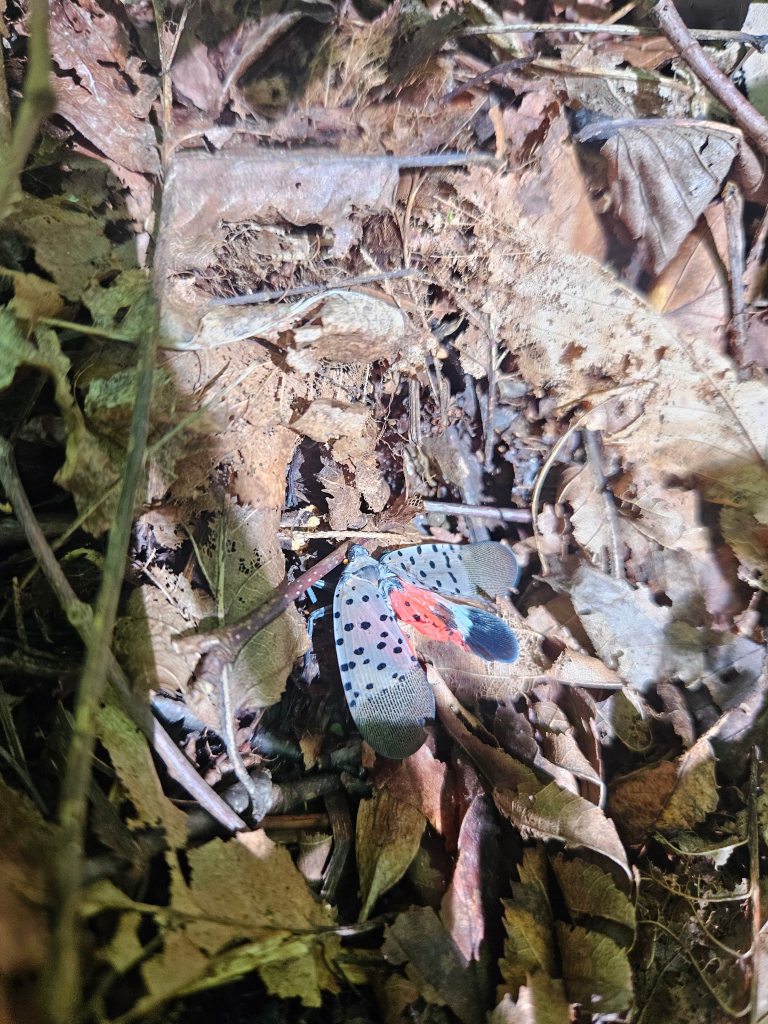
Spotted lanternfly adults feed on more than 70 species of plants and have the potential to severely impact Connecticut’s agricultural crops particularly apples, grapes, hops and ornamental trees.
Approximately half of Connecticut’s trees are threatened by a spotted lanternfly invasion, according to the Connecticut’s Department of Energy and Environmental Protection (DEEP). As spotted lanternfly nymphs and adults feed on the sap from trees and vines, the entire plant can become weakened. The excretions from these leaf-hopping insects encourage the growth of black sooty mold, thereby reducing photosynthesis.
Agricultural crops will have reduced yields due to the SLF feeding on fruit and generally weakening plants, if not destroying them. Its preferred host, the tree-of-heaven (Ailanthus altissima), is highly invasive and is abundant along highways, in urban areas and along the edges of agricultural and industrial areas, where the spotted lanternfly can easily become established.
The spotted lanternfly (Lycorma delicatula) is not a fly, but rather is an exotic, invasive sap-feeding planthopper first discovered in the U.S. in Pennsylvania in 2014. It is thought to have been introduced around 2012 through a contaminated stone shipment from Asia. The insect lays its egg masses on hard surfaces where they resemble dried mud.
After establishing itself, the insect spread across the U.S., primarily through human assistance with its inconspicuous egg masses and adult forms hitchhiking on vehicles, firewood, outdoor furniture, and other objects. The lanternfly is not a strong flyer, but from August through November the adults may attach themselves to or enter vehicles, trailers and even clothing, “hitch hiking” their way along.

The Connecticut and the Department of Transportation is partnering with the U.S Department of Agriculture, the Connecticut Agricultural Experiment Station and DEEP in asking travelers and residents to be on the lookout for these “hitch hikers.” Travel corridors have been linked to the spread of this invasive insect.
This pattern is evident in Connecticut where spotted lanternflies have established populations in Fairfield, Hartford, Litchfield, Middlesex, New Haven and New London counties, with sightings reported across all eight counties in the state.
Established populations are particularly dense in Fairfield and New Haven counties, especially along the I-95 and I-91 corridors. Towns with reported populations are Greenwich, Stamford, New Canaan, Norwalk, Fairfield and Westport.
Travelers and residents alike are asked to check their vehicles and if the insect is found, to take its picture, destroy it and report it to the Connecticut Agricultural Experiment Station. Permission by residents and businesses for state and federal plant inspectors to examine host trees on private property will be helpful in determining the extent of the infestation. All reports are confidential.

