

KENT, Conn.—The bell atop the Eric Sloan Museum rang out Saturday afternoon, just a Sloane would have wanted it to. It commemorated the birth of a new nation—just as bells have since they first pealed forth at 2 p.m. on July 4, 1776, in Philadelphia.

A handful of area residents, mindful of what is perhaps the nation’s most symbolic holiday, gathered on the museum’s lawn, ready to participate in a ritualized ringing.
Forming a line, they each took a hand in pulling the rope that sent the clapper clanging against the bell’s metal side for a total of two minutes.
Before ringing the bell, the audience listened to a reading of the Preamble to the Declaration of Independence by museum director Andrew Rowand. He told the crowd that this ritual has been enacted at the museum for the past 57 years, ever since the museum was opened in 1969.

But Sloane’s obsession with the symbolism of bells predates the installation of the bell atop his museum. Sloane, an artist, and Eric Hatch, an author, collaborated on the “Let Freedom Ring” project in the early 1960s, promoting a concept born in a Sloane interview from July 1962.
During that interview, Sloane spoke of the early American tradition of ringing bells in celebration of the nation’s independence. He said he preferred it to the more modern tradition of firework displays, believing that bells produce a sound of “peace,” compared to more war-like fireworks.
Listeners responded enthusiastically to Sloane’s idea in the 1960s, and the “Committee of the Two Erics” began an article and letter writing campaign that ultimately led to a joint congressional proclamation, adopted June 26, 1963, and signed by President John F. Kennedy. It called for bells to be rung across America in commemoration of the nation’s independence.
Only five years later, Sloane created his own museum in Kent, prompted by the Stanley Tool company, which donated the land and structure to the state. The purpose was to display Sloane’s impressive collection of Early American tools, which he personally displayed. The collection still includes signs crafted by the artist himself.

According to Rowand, the building has since been expanded twice and now includes a replica of Sloane’s art studio as well as a collection of his paintings.
Sloane was well aware of the property where his museum now stands long before the Stanley Tool company donated it to the state. According to Rowand, it used to be the town’s dump and annually Sloane would come there for a picnic with Bart Segar, a World War II veteran and one of Kent’s notable characters, to celebrate Segar’s birthday.
“Eric was very glad to have the museum here, to have the grounds cleaned up and for the Kent Iron Furnace to be made accessible to the public,” said Rowand.
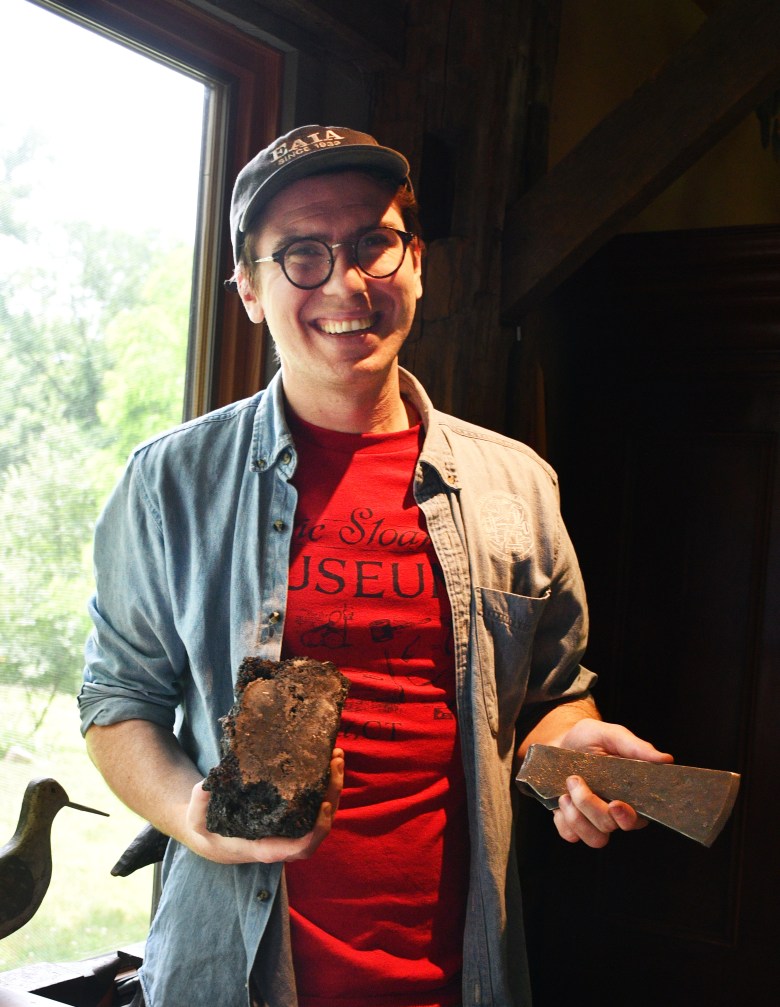
The museum has just received an additional legacy of the iron era in a collection of ledgers and other materials from the Kent furnace donated by the Coe family of Washington, Conn. The materials came from the collection of Howard Coe, who was formerly employed by Stanley Tools.
Rowand promised that the bell ringing ceremony will be a bigger affair next year when the town celebrates the nation’s 250th anniversary. The anniversary will coincide with the 200th anniversary of the Kent Furnace, a historic 1826 granite blast furnace with Gothic arches that produced pig iron for almost 70 years and is now listed on the National Register of Historic Places.
In 2026 the anniversary will be commemorated with demonstrations of smelting as well as other activities. Kent’s 250 Committee also hopes to use one of Sloane’s bell drawings on its semiquincentennial materials and to distribute little handbells that celebrants can ring during festivities.

